 Gondola Rides in Venice
Are Gondolas in Venice Safe? Honest Answer + Who Shouldn't Go
Last reviewed September 2026
Are gondolas in Venice safe is a question this site answers honestly rather than reassuringly: no authority publishes an accident or fatality count for gondolas in Venice, and this guide does not invent, estimate or borrow one from a news story to fill that gap. The gondola rides in Venice we list are all governed by the same municipal rules, so this applies to every one of them. What does exist, and what this page covers instead, is a detailed municipal regulation governing how every gondola is built, how it's crewed, what happens when acqua alta or wind or rain interrupts a ride, and which travellers should think twice before booking one.
Quick answer No accident count is published; the safety layer is the regulation, not a statistic
No authority publishes an accident or fatality count for gondolas in Venice, and this site does not invent one. What is published, in detail, is the municipal regulation that governs every gondola and gondolier in the city: hull construction, a compulsory bow light, a five-passenger cap, and rules enforced by a dedicated city desk. It isn't risk-free, and it genuinely isn't for everyone: age isn't the gate, but weight, mobility and swimming ability can be.
Key takeaways
- No published accident statistic exists for Venice gondolas. What is published is the regulation instead
- Every gondola is built to a municipal specification: glossy black hull, a compulsory bow light from sunset to dawn
- One operator not carried on this site declines non-swimmers, passengers over 150kg, or over 95. See the full restrictions table
- Acqua alta's raised-walkway service runs 15 September to 30 April; the city's warning sirens count out the expected level
- Every listing we compare offers free cancellation, which every Venice gondola ride listed here carries up to 24 hours before the ride. What happens to your money if weather cancels it
- The Comune's complaint desk is DIME under Segnalazioni, or Call Center Unico 041 041
Who Should Reconsider
If You or a member of your party cannot swim
Ask before booking. One Venice operator not carried on this site declines non-swimmers outright, and no listing compared here mentions flotation equipment of any kind.
If Anyone in your party has significant mobility limitations
Boarding is a step down onto a moving pontoon into a low seat. See the restrictions table below before booking.
If You're travelling with a combined party weight that might be significant
One operator not carried on this site sets an individual cap of 150kg; ask any operator directly if your party is near that figure.
If You're booking around a specific date in September through April
That window overlaps the acqua alta season. Read what stops a ride and what happens to your money before you commit to a fixed date.
If None of the above applies to you
The standard restrictions are minimal. See the full table for the complete list any operator here might enforce.
What the Numbers Say, and What Is Not Published
This is the honest core of the question, and the honest answer is that the number most searchers want simply isn't published anywhere.
No authority publishes an accident count
No authority publishes a gondola incident or fatality count for Venice, and this site does not invent one, estimate one, or borrow one from a news report. That isn't evasiveness on this page's part: it's an accurate description of what's actually available from the Comune di Venezia and other public sources. A number with no denominator and no named source is worse than no number at all, and this guide would rather say plainly that the figure doesn't exist than manufacture false precision.
What is published, in real detail, is the regulation that governs every boat and every gondolier operating in the city. That regulation is where this page's actual safety case is made: not a statistic, but a specification. The full text is here, and it covers hull construction, crew uniform, lighting, and passenger limits in enforceable detail rather than marketing language.
What is published instead is specific. A gondola carries 5 passengers and no more. A white 360-degree light is compulsory at the bow from sunset to dawn. The tariff has to hang at every mooring in 5 languages. The city's high-water walkway service runs from 15 September to 30 April, and its sirens signal the expected tide by counting tones at 110 cm, 120 cm, 130 cm and 140 cm. Complaints go to 041 041, open 08:00 to 18:00. That is the safety layer, and every figure in it is checkable.
Is Venice itself safe to visit?
That's a different question from the one this page answers, and it's worth separating explicitly. This guide covers activity safety on a gondola only. For destination-level safety, meaning crime, political stability or travel advisories, the right source is your own government's official travel-advisory system (the US State Department's four-level system, the UK FCDO's country pages, or the equivalent for your nationality), not an opinion on this page.
This page returns to the activity-safety question from here on, and to which gondola rides in Venice we compare once the safety questions are answered.
What Makes It Safer Here: the Municipal Regulation and Who Enforces It
Venice regulates its gondolas the way it regulates its water buses: publicly, specifically, and with a named enforcement route rather than an implied one.
Built to a specification, not a preference
Every gondola in public service is built to a municipal specification under the regulation: hull glossy black inside and out, to traditional measurements, with a steel prow (the ferro) made in a single piece with six teeth, and a compulsory white 360-degree light at the bow from sunset to dawn. None of this is up to an individual gondolier's taste. It's enforced construction and lighting standard, checked against a public document rather than taken on trust.
Crew uniform is regulated too, down to shirt-stripe width, which is a small detail that signals a larger point: this is licensed, inspected work, not an informal trade.
Five passengers, weight-balanced seating, no standing
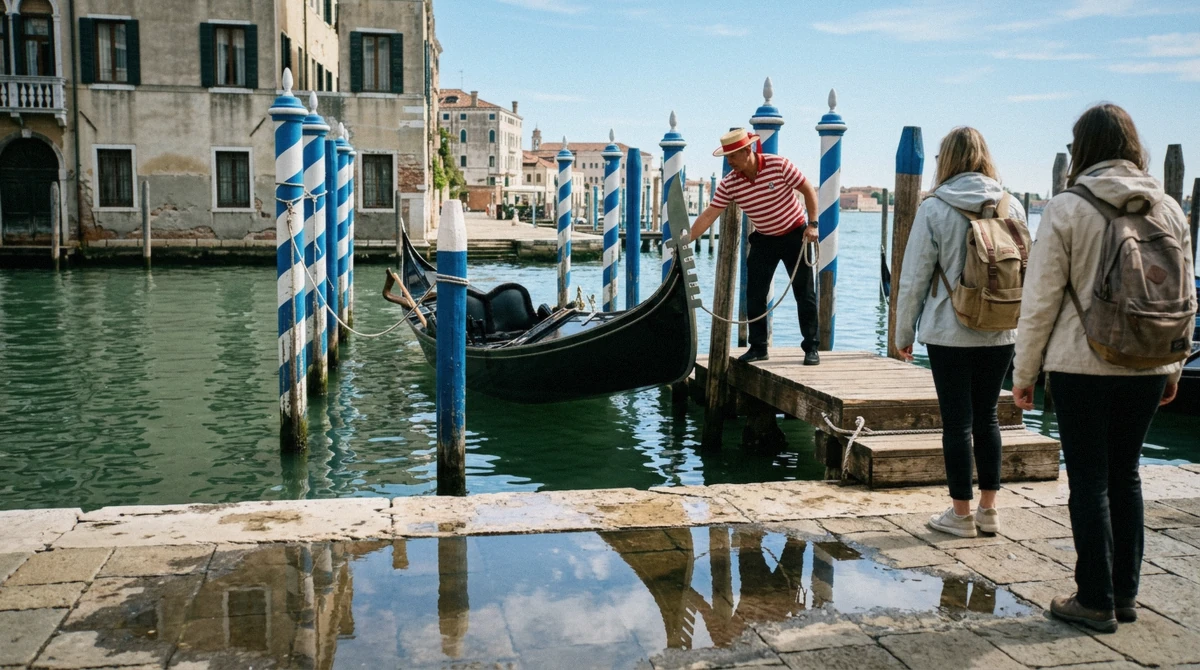
Five passengers is the legal maximum under the regulation, and seats aboard are assigned by the gondolier rather than chosen freely by passengers, partly to balance an asymmetric hull that handles badly loaded wrong. No listing compared here permits standing up during the ride. This is the one rule that shows up consistently across every operator's own terms, independent of the municipal minimum.
Enforcement has a named desk
The tariff table must be displayed at every stazio and pontile in five languages, and failure to display it is classed as a serious violation, not a technicality. Complaints of any kind go to the city's DIME digital desk under Segnalazioni, or to the Call Center Unico on 041 041, open 08:00 to 18:00. Regulation that's genuinely thin gets said plainly on this site rather than implied away, but the enforcement route here is real and named, which is itself a meaningful part of the safety picture: your main lever as a traveller is choosing an operator that plays by a rule set with a real complaint desk behind it and a fare you already know before you board.
On-Board Rules That Exist for a Reason
A handful of concrete rules cover most of the real risk on a gondola ride, and each pairs with a specific reason rather than a blanket "safety first" line.
The rules, and why they exist
No standing up during the ride is the rule every operator states, because a gondola is a narrow, asymmetric hull with a low freeboard: standing shifts weight in a way the boat isn't designed to absorb mid-ride. Seats are assigned by the gondolier rather than left to passengers, again for weight balance, so where you sit isn't a courtesy question but a stability one. Large bags aren't allowed on most listings, which keeps loose weight and loose objects out of a boat with no storage.
And the tariff-display requirement, beyond being a consumer protection, is a proxy signal: an operator following the small, visible rules is more likely to be following the ones you can't see from the quay.
| Situation | What a good operator does | Warning sign |
|---|---|---|
| Boarding at a busy mooring | Orderly, one party at a time, gondolier steadying the boat | Rushed boarding while the boat is still moving |
| Open-basin crossing in wind | Route adjusted or ride shortened per the regulation's allowance | Pushing ahead into conditions other gondolas have stopped for |
| A passenger asks to stand for a photo | A firm, polite no, consistently enforced | Any gondolier who allows it |
| Weather turns during the ride | Early, honest return to the mooring with free cancellation for the shortened portion | Continuing regardless while passengers look uneasy |
Water quality and valuables
A gondola ride involves no food or drink service on the standard listings and no immersion in the water, so there's no genuine hygiene exposure to speak of beyond ordinary travel sense. Theft is a low-risk aside rather than a real concern on a supervised, thirty-minute ride with a crew of one gondolier in view the whole time. The real exposure point is an unattended bag at a crowded meeting point before boarding, not the boat itself.
A small crossbody bag rather than something set down and forgotten covers it.
Acqua Alta, Wind and Rain: What Stops a Ride
Weather is the more common disruption than any safety incident, and Venice has a public, well-documented system for tracking and warning about it.
Gondolas run in the rain
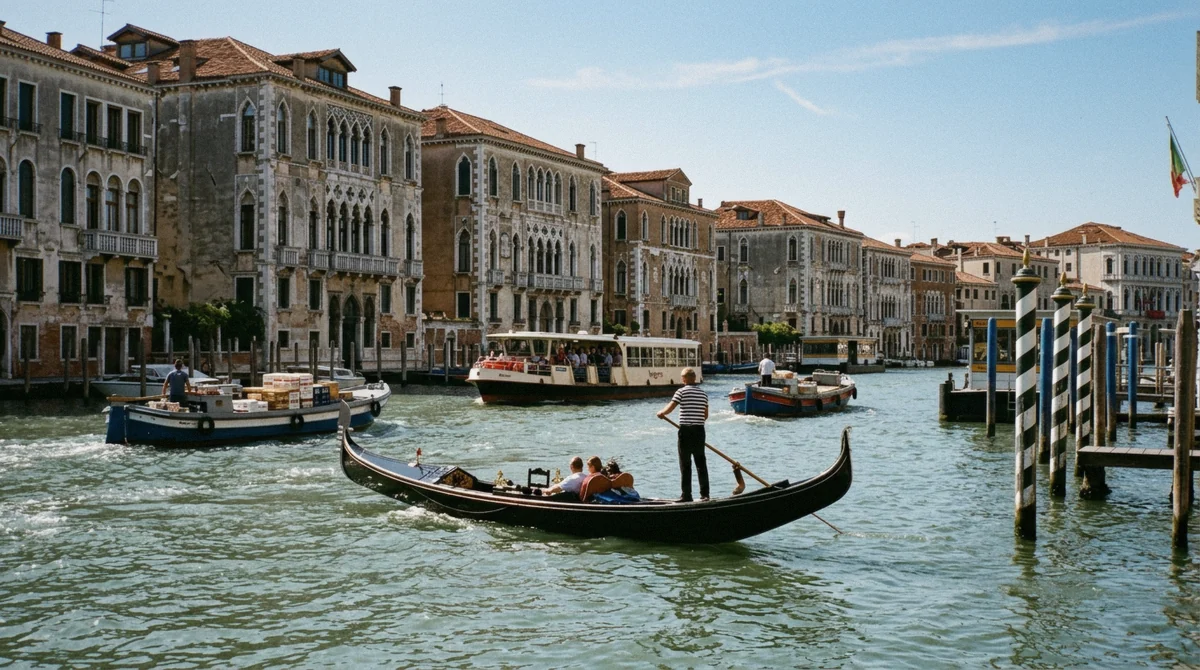
Gondolas run in ordinary rain. A wet day alone doesn't cancel a booking. What does interrupt or cancel a ride is exceptional high tide, heavy rain, or wind on the open basin crossings, and every listing that addresses this states the same outcome: a shortened or cancelled ride, with a refund.
Acqua alta, explained plainly
The Comune's raised-walkway (passerelle) service for high water runs from 15 September to 30 April and is suspended from 1 May. That window is the city's own operational definition of the high-water season, and it's the period worth watching most closely if you're booking a fixed-date gondola ride. Our best-time guide covers the calmer, drier months in more depth if a specific season is still up for choosing. The Comune's Centro Maree page carries real-time tide readings and forecasts, and a public Telegram channel (@centromareevenezia_bot) mirrors the same data.
When a high tide is expected, the city sounds warning sirens that count out the forecast level in tones: one long note for 110cm, two rising notes for 120cm, three for 130cm, and four for 140cm and above. This is a real, public system, not a vague warning. If you hear the sirens while in Venice, the number of tones tells you roughly what's coming.
MOSE, the mobile barrier system at the three lagoon inlets, has been operational since October 2020 and is raised against forecast tides above roughly 110cm. Its exact activation threshold has shifted between seasons, so this guide describes it in general terms rather than quoting a specific per-season closure count that would go stale.
What Happens to Your Money If It's Cancelled
Every listing we compare handles weather cancellation the same broad way, with free cancellation as the baseline protection regardless of the reason.
The refund pattern across the eleven listings
Free cancellation up to 24 hours before the start applies on every ride compared here, independent of weather: book, then cancel for any reason inside that window at no cost. Weather-specific cancellation, where an operator shortens or cancels a ride already underway or about to start because of exceptional high tide, heavy rain or wind, is handled with a refund on the listings that address it directly.
| Situation | Typical outcome | What to do |
|---|---|---|
| You cancel more than 24 hours ahead | Full refund, no reason required | Cancel through the platform you booked on |
| You cancel inside 24 hours | Depends on the listing's stated policy | Check the specific cancellation terms at checkout before assuming |
| Operator shortens the ride for exceptional high tide, heavy rain or wind | Refund for the affected portion, per the operator's own terms | Confirm the refund method (original payment vs. credit) with the operator directly |
| Operator cancels entirely before departure | Refund per the listing's stated policy | Rebooking a different time slot is usually offered alongside a refund |
Travel insurance and the activity itself
A separate question from the trip-cost refund above is whether travel insurance covers an injury or medical event during the activity itself. That's about health and evacuation coverage, not booking cancellation. Standard travel policies sometimes exclude named adventure activities, though a gondola ride is a low-exertion activity unlikely to sit on most such exclusion lists; check your specific policy rather than assume either way.
Who Shouldn't Do It: Restrictions at a Glance
Every restriction below is pulled from operator listings or the municipal regulation. Nothing here is invented, and nothing that applies is omitted.
The full restriction set
Most of the eleven listings we compare state few restrictions beyond the no-standing rule and the five-passenger cap. The table below draws on what the compared operators and one Venice operator not carried on this site actually state, cited as "one operator" without naming it, per this site's editorial policy.
| Restriction | Typical rule on Venice gondola tours | Why it exists | Ask before booking if… |
|---|---|---|---|
| Minimum age | None stated by any of the eleven compared listings | No operator enforces a floor | You're travelling with an infant and want written confirmation |
| Maximum age | One Venice operator not carried on this site declines passengers over 95 | Physical boarding demands, at the operator's discretion | A member of your party is of very advanced age and you want certainty |
| Group headcount | 5 passengers maximum, children and babies included | Municipal hull capacity limit | Your party is exactly 5 or 6 and you need to know whether a second boat is required |
| Weight (individual) | One operator not carried on this site caps individual weight at 150kg | Boarding and hull-balance safety | Any individual in your party may be near that figure |
| Weight (combined) | Not separately stated by any compared listing | n/a on the listings we compare | You have a very large combined party weight; ask the operator directly |
| Mobility limitations | Not suitable for people with significant mobility impairments (stated by one compared listing) | The pontoon step down and low, fixed seating | Anyone in your party uses a mobility aid or has difficulty with a stepped, moving boarding surface |
| Swimming ability | One Venice operator not carried on this site declines non-swimmers | No flotation equipment is provided on any listing here | Anyone in your party cannot swim |
| Life jackets | Not mentioned by any compared listing | Not provided on any listing here; do not assume otherwise | You specifically require flotation equipment for peace of mind |
| Standing during the ride | Prohibited on every listing compared | Hull stability | n/a, applies to everyone, always |
How to Choose a Ride If Safety Is Your First Question
Choosing well is the one safety lever a traveller actually controls, and it's a matter of a few concrete checks rather than a leap of faith.
What to look for, and what to avoid
A good sign before boarding: a tariff table visibly displayed at the mooring, an unhurried boarding process, and a gondolier who steadies the boat rather than waving passengers aboard while it's still moving. A red flag is the opposite of all three: no visible tariff table, a rushed handoff into a still-moving boat, or a gondolier pushing ahead into conditions other boats nearby have already paused for. An unattended waiver, one signed without a moment to read it, is worth the same suspicion.
Among the listings we compare, the private Grand Canal ride and the off-the-beaten-path private ride both give you the whole boat rather than a seat assigned among strangers, which removes one variable entirely for a nervous first-timer. If a shared boat and its lower price suit you better, the traditional shared gondola ride is the most established of the compared listings; book its seat-together option if travelling as a group, and see our with-kids guide if children are part of that group. Either category is a reasonable starting point if safety and predictability are your first filter, alongside checking that free cancellation applies to whichever date you book.
What If Something Goes Wrong: Scenarios, Honestly
A short, honest walk-through of the realistic situations, not worst-case fear-bait.
The tide rises faster than forecast
What happens: the gondolier monitors conditions throughout and, per the regulation's own allowance for variable duration, can shorten or reroute the ride if the water rises. What the operator does: ends the ride early rather than pushing into open-basin conditions, and the listings that address this refund the shortened portion. What you should do: if a gondolier suggests turning back early, treat it as the correct call rather than a disappointment.
It's the system working as intended.
A passenger feels unsteady or anxious mid-ride
What happens: the low, fixed seating and no-standing rule mean there's little room for the situation to escalate physically. What the operator does: a competent gondolier will slow or pause rowing briefly and talk a passenger through it rather than press on regardless. What you should do: say something early rather than trying to push through in silence.
Communicating with the gondolier is the entire toolkit here, and it works.
You realize after booking that someone in your party has an undisclosed condition or limitation
What happens: nothing automatic. The operator only knows what you tell them. What the operator does: nothing, until informed.
What you should do: this is the one safety lever entirely in your hands. Disclose a genuine mobility, swimming or medical concern to the operator before boarding rather than discovering the problem at the pontoon step. It's the single thing most likely to change your outcome, more than any equipment or regulation on this page.
Safer Alternatives If You're Excluded
A gondola isn't the only way to see Venice from the water, and the genuine alternative for an excluded reader is worth naming rather than leaving as a dead end.
If a gondola isn't the right fit
The walking tour with a gondola ride option lets you take the walking portion alone and skip the boat entirely if mobility, swimming ability or another restriction rules the gondola itself out. You still see the city and its canals from the quay and the bridges, without the boarding step. It's the one product among the eleven we compare genuinely structured to work either way.
Gondola Safety in Venice: Common Questions
Has anyone died on a gondola ride in Venice?
No authority publishes an accident or fatality count for gondolas in Venice, and this site does not invent, estimate, or repeat one from an individual news story. What is published in real detail is the regulation covering construction, crew conduct and passenger limits. See the safety record section above.
Is there a weight limit for a gondola ride?
One Venice operator not carried on this site sets an individual cap of 150kg. No listing we compare states a separate combined-weight limit; ask directly if it's a concern for your party.
Is there an age limit for a gondola ride in Venice?
No minimum age is stated by any listing we compare. One Venice operator not carried on this site declines passengers over 95. See the full restrictions table.
Is a gondola ride safe with a heart condition or high blood pressure?
No listing we compare states a specific restriction for cardiac conditions. A gondola is a low-exertion, seated activity. If in doubt, a conversation with your own doctor before travel is the right move, not a verdict from this page.
Is a gondola ride safe for non-swimmers?
One Venice operator not carried on this site declines non-swimmers outright, and no listing here provides flotation equipment. If swimming ability is a genuine concern, ask the operator directly before booking.
What happens if the weather turns bad mid-tour?
Gondolas run in ordinary rain. Exceptional high tide, heavy rain or wind can shorten or cancel a ride, and the refund pattern is covered above. Free cancellation applies up to 24 hours before the start on every listing regardless.
Are life jackets provided on a gondola ride?
No listing we compare mentions life jackets. None should be assumed provided or required.